
Chief executive officers (CEOs) across sectors have expressed intentions to expand capacities, expecting the government's target to invest a record Rs 11.11 trillion on infrastructure development will act as a catalyst for a jump in consumer demand. "With the government planning a capex of Rs 11.11 trillion, private sector investment will come in a big way. Companies will be preparing for it right from today," H M Bangur, chairman of Shree Cement, told Business Standard. For the past few years, the investment scene in India has been dominated by government capital expenditures; private investments in the manufacturing sector have remained muted.

Economic Survey which was tabled in the Parliament on Wednesday projects 6.1 to 6.7 per cent growth rate for 2013-14.

The Indian government's announcement of 10,000 additional seats in medical colleges next year, part of a plan to add 75,000 seats over five years, has been welcomed by education experts and stakeholders. The move aims to address the shortage of medical professionals and reduce the outflow of Indian medical students to other countries. The budget also includes infrastructure expansion at five new IITs to accommodate 6,500 more students and an allocation of Rs 500 crore to set up a Centre of Excellence in Artificial Intelligence for education.

The Survey says that present skilled workforce in India is only 2%.

Making a case for reforms in the pension sector, the Economic Survey 2010-11 on Friday said the Parliament should expeditiously clear the long pending PFRDA Bill.
These ID cards would form the base of a multi-application smart cards system that can be used to empower the poor and ensure that they get full benefit of all programmes such as NREGA, PDS, biblically provided education, skill development, heath services, social security and fertiliser subsidy etc, it added.

The government has invited applications for the post of chief economic adviser (CEA) to replace K V Subramanian, who will complete his three-year tenure next month. Subramanian was appointed as CEA on December 7, 2018, while he assumed charge on December 24 in the same year. As per the public notice dated October 24, 2021 issued by Department of Economic Affairs, the Ministry of Finance, officer of central, state governments, RBI and public sector banks holding analogous post on regular basis in parent cadres or department are eligible to apply for the post.

Outlook for external sector is the most favourable.
The government today extended the tenure of Chief Economic Adviser Arvind Virmani by three months on a temporary basis, said a finance ministry spokesperson. His current two-year term came to an end on Tuesday.

Retail inflation during the first month of the current fiscal stood at 2.9 per cent, down from 4.6 per cent a year ago. Food inflation based on Consumer Food Price Index declined to a low of 0.1 per cent during the financial year 2018-19, the survey said.

Battle lines have already been drawn and the opposition has insisted on a debate on demonetisation.
Marketmen feel the reformist wishlist prescription for the government for next five years though presents a good road-map for future growth but is hard to implement. The Economic Survey mooted the idea of doing away with cess, surcharges on taxes and initiating reforms in petrol pricing and financial sector, besides recommending a disinvestment target of Rs 25,000 crore (Rs 250 billion) annually.
The Economic Survey prescribed on Thursday a new bankruptcy law for ensuring speedy disposal of insolvency petitions. Tabled in parliament, the survey called for a new bankruptcy law to 'ensure speedy and effective bankruptcy so as to save/preserve assets for alternative use.'

'Mamata needs to address the anger and resentment among various sections of the Hindu community because low-scale communal violence has always paid richer electoral dividends for the BJP.'
The rupee had depreciated sharply during the last six months of 2011. It had reached a peak of Rs 43.94 to the dollar on July 27, 2011, and hit a low of Rs 54.23 on December 15, 2011.

Terming investment in infrastructure "quintessential" to boost growth, the Economic Survey on Friday said post unlocking of the economy, infra sectors are poised for growth and construction of roads is expected to return to the high pace attained before COVID-19. The infrastructure sector will be the key to overall economic growth and macroeconomic stability, the Survey said emphasising that the year after the crisis (2021-22) will require sustained and calibrated measures to facilitate the process of economic recovery and enable the economy to get back on its long-term growth trajectory. "Basic infrastructure facilities in the country provide the foundation of growth. In the absence of adequate infrastructure, the economy operates at a suboptimal level and remains distant from its potential and frontier growth trajectory.
The headline inflation is expected to decline to 6.2-6.6 per cent in March 2013.

Amid increasing problems faced in acquiring forest lands for commercial purposes, the Survey for 2010-11 tabled in Parliament said there should be parity in the compensation package paid. It said there was an 'urgent need to streamline land acquisition and environment clearance for infrastructure projects.'
The investment by FIIs in equity instruments amounted to $5.4 billion during April-May 2009, while a turnaround has been noticed in the performance of mutual fund industry that had remained subdued during 2008, the survey stated. The mutual fund investments (net) in equity markets turned positive in March 2009 and were Rs 2,320 crore (Rs 23.2 billion) during April-May 2009, the survey said, adding they invested Rs 36,791 crore (Rs 367.91 billion) in debt instruments.

India's sovereign credit ratings do not reflect the economy's fundamentals, the Economic Survey said on Friday and nudged the global agencies to become more transparent and less subjective in their ratings. The Economic Survey 2020-21, tabled in Parliament, said that sovereign credit ratings methodology must be amended to reflect economies' ability and willingness to pay their debt obligations, and suggested that developing economies must come together to address this bias and subjectivity inherent in sovereign credit ratings methodology. "Never in the history of sovereign credit ratings has the fifth largest economy in the world been rated as the lowest rung of the investment-grade (BBB-/Baa3). While sovereign credit ratings do not reflect the Indian economy's fundamentals, noisy, opaque and biased credit ratings damage FPI flows," the survey said.

'The fiscal deficit target of 3.9 per cent of GDP seems achievable.'
India needs to fully open its retail market to foreign investors in order to drive economic growth, although the subject was strictly taboo till last year because of pressure from the government's allies and livelihood concerns.

The Economic Survey 2011-12 on Thursday made a case for allowing foreign airlines to invest in domestic carriers, a suggestion that will enable the ailing sector to access overseas capital and expertise.

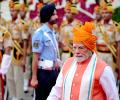
Gandhi, who is usually flanked by senior party colleagues, was also greeted by both President Droupadi Murmu and Vice President Jagdeep Dhankhar.

Following are the highlights of the Economic Survey 2022-23 tabled in Parliament on Tuesday
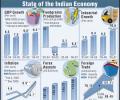
The survey is a report card on the nation's economy, tabled before the Budget, and is the finance minister's review of the economy and his assessment of the prospects of the economy.
The survey pointed out that the transmission and distribution losses in the power sector, at 35 per cent, were among the highest in the world.

The Economic Survey said that a number of indicators -- GDP, IIP, credit, investment and capacity utilisation, point to a deceleration in real activity since first quarter of 2016-17 and a further deceleration since the third quarter.
Identifying the need for Rs 1,72,000 crore (Rs 1720 billion) investment in national highways, the Economic Survey on Monday asked the government to gear up policies and institutions to meet specific requirements while increasing the outlay for road s
'The Election Commission's involvement in the avoidable SIR controversy has carried a message down to the last voter -- who just does not like it,' observes N Sathiya Moorthy.
It pointed out that the capital market scenario in 2008 should be seen in the backdrop of heightened uncertainties triggered by the international financial crisis, slowdown in the global economic growth, fluctuations in international food, commodity and fuel prices and volatility in overseas financial markets.
Buoyed by about 19 per cent jump in tax collection, the government may further moderate taxes in the Budget with the Economic Survey on Monday prescribing a tax reform mantra to unburden India Inc.
Suggesting delinking of spectrum from telecom licences, the Economic Survey for the year 2008-09 has suggested auctioning radio frequencies for the forthcoming 3G mobile services.

Finance Minister Nirmala Sitharaman will present the Union Budget on Tuesday as the Monsoon Session of Parliament gets underway next week with the united opposition set to corner the National Democratic Alliance government on issues ranging from the NEET paper leak case and railway safety.

The growth of the Indian pharmaceutical industry has been fuelled by exports, which increased 25 per cent in 2008-09. "Exports of pharmaceuticals have consistently outstripped imports," the Survey said.
Stung by the low 4.4 per cent growth projection for this fiscal, the pre-Budget Economic Survey on Thursday endorsed Kelkar Panel recommendations on tax reforms besides a cut in subsidies and interest rates to deal with mounting and worrying fiscal d

A united opposition is set to corner the NDA government on issues ranging from the NEET paper leak case to railway safety.
The controversial VVIP chopper scam is set to turn the three-month-long Budget session of Parliament beginning Thursday into a troubled affair for the government with the Opposition raring for an attack eyeing the Lok Sabha polls which are not far away.

A cross-country comparison shows that India currently has the lowest number of taxpayers.

Referring to the impact of political turmoil in West Asia, he said the crisis would not hurt the economy unless the crude oil prices rise to 'abnormally' high levels.
